Thursday, 22 September 2022

Teachers' Day


Hello Readers, in this Blog I am writing down here about the Teachers' day celebration in the Department of English Maharaja Krishnakumarsinhji Bhavnagar University.

I am preparing a Youtube video on the occasion of Teachers' day 2022. For this video, I choose the topic of Animal Farm which was written by George Orwell.

"The animals were happy as they had never conceived it possible to be. Every mouthful of food was an acute positive pleasure, now that it was truly their own food, produced by themselves and for themselves, not doled out to them by a grudging master." - George Orwell, Animal Farm

I am putting here my video...


 I also prepared a quiz and those who are given the quiz all get a certificate for this quiz. So here I am putting my link to the quiz.

https://forms.gle/9xrDstHrVizrSmE69

        I kindly request to all of you please watch my video and gave the quiz and get your certificate.     

Thank you...                               


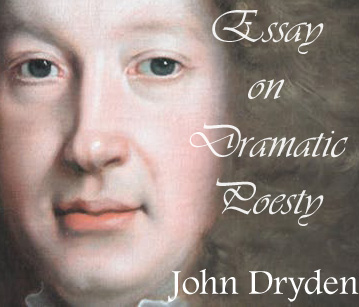
Dryden On Dramatic Poesy

 Bridge course:- Thinking activity

Dryden- On Dramatic Poesy


Hello Readers, in this Bridge course Thinking activity Blog I am writing down here about my understanding of the Dryden-on Dramatic essay and I am also giving the answer to some questions, Which is given by Dr. Dilip Barad sir, Department of English Maharaja Krishnakumarsinhji Bhavnagar University

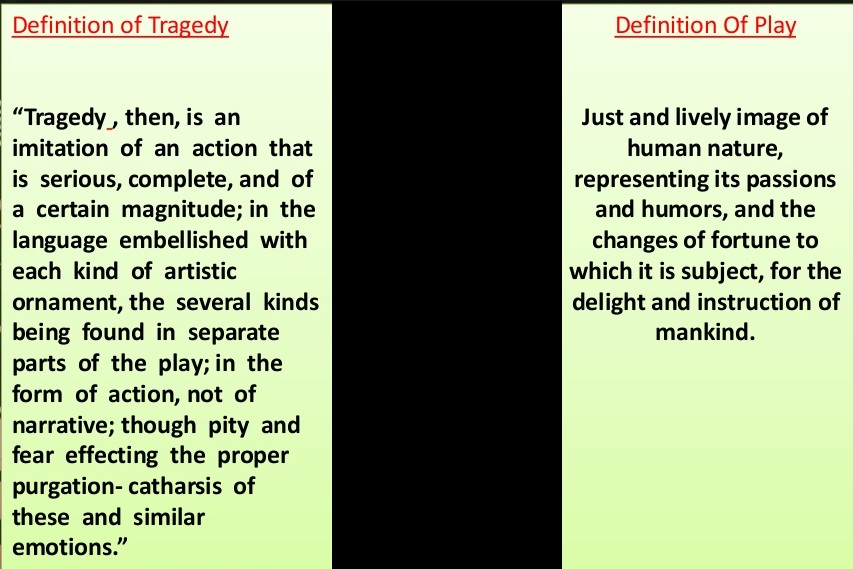
1) Do you any difference between Aristotle's definition of Tragedy and Dryden's definition of Play?

 Difference Between Aristotle's Tragedy and Dryden's Play:


Definition of Tragedy Aristotle:-

"Tragedy, then, is an imitation of an action that is serious, complete, and of a certain magnitude; in language embellished with each kind of artistic ornament, the several kinds being found in separate parts of the play; in the form of action, not of narrati
ve; through pity and fear effecting the proper purgation of these emotions.

Aristotle begins to introduce the six constitutive components of a tragedy. The first in the discussion is a spectacle, which includes the costuming of the actors, the scenery, and all other aspects that contribute to the visual experience of the play. The play is dependent on action. It has speeches, dialogue, and soliloquies. In Aristotle’s tragedy, pity and fear are more important. At last, comes, catharsis. The emotions become free from the body.

"A well constructed plot should, therefore, be single in its issue, rather than double as some maintain."

 Aristotle describes the components parts or characteristics which are required to make a tragedy. The second constituent of tragedy is character. According to Aristotle, there are five things to be aimed at in a character.

1) The Spectacle (opsis)
2) Melody/songs (Melos)
3) Diction (lexis)
4) Character (othes)
5) Thought (dianoia)


According to Aristotle tragedy should be presented in the form of action, not narration. He distinguishes tragedy from the epic because an epic narrates the events and does not represent them through actionAristotle every tragedy has six constituents, which determine its quality. They are character, plot, diction, thought, spectacle, and song. Plot, character, and thought are the objects of imitation, diction, and song are the media of imitation, and spectacle and song are the manners of imitation in tragedy.

Introduction of John Dryden:-


“I am sore wounded but not slain I will lay me down and bleed a whileAnd then rise up to fight again”― John Dryden
 John Dryden (1631-1700) was a prominent English poet, critic, translator, and playwright. He was a neo-classical poet and his age come after the Elizabeth age. Dryden was the father of English literature, who dominated the literary life of the Restoration age. Dryden's mature thought of literary criticism on ancient, modern, and English literature, especially on drama is presented in dialogues from “An Essay on Dramatic poesy”. His some works here I note down – The wild Gallant, The Indian Queen, The Tempest, All for love, An Evening's Love, Sir Martin Mar-all, The Assignation, Limberham, or the King Keeper.
“Happy the man, and happy he alone, He who can call today his own: He who, secure within, can say, Tomorrow do thy worst, for I have lived today.”

 He defends the classical theory of drama saying that it is an imitation of life and reflects human nature clearly.

His definition of the play :

      "A play ought to be a just and lively image of human nature, representing its passion and humours, and the change of fortune to which it is subject, for the delight and instruction of mankind".

 Throughout, 'The Essay of Dramatic poesy' Dryden treats drama as a form of imagination literature and hence his remarks on drama apply to poetry as well.

Dryden's one quote related to word delight his view on delight word here  I write
this quote:

       "Criticism, as it was first instituted by Aristotle, was meant as a standard of judging well; the chiefest part of which is to observe those excellencies which delight a reasonable reader".

Comparing the Definitions:-

 Although Dryden is taking an influence from Aristotle’s definition of tragedy and makes his own. How he carried over the tradition. Dryden used the words ‘Just
and Lively’ image, which means real life. When real life is presented in play one must to be involved in the play then. The catharsis comes which is the last part of Aristotle’s definition of tragedy.
 In Aristotle’s definition the line, 'Tragedy, then is an imitation of an action. Which says that tragedy is an imitation not an actual so it is copied. Where there in Dryden’s definition. The line says 'just and lively image' here 'just' means exact. As it is real so the image is in mind but the way matters how you use to give it a form of visual to others. So it becomes the natural way.

 Aristotle's definition of tragedy has three parts. First is a lovely image of human nature, and second is it represents passions and humor and changes in the future. And third is its purpose which gives delight and instructions to mankind. Aristotle's tragedy ends with Catharsis whereas Dryden’s play ends with delight and instruction. I can see other differences between Aristotle's and Dryden’s definition that tragedy has sadness end whereas play has a pleasure and delightness end. Tragedy creates seriousness whereas play represents humour.

Comparing Characteristics:-

The most important characteristics Unities of time place and action. Aristotle supports these three unities in his tragedy but Dryden breaks these unities. He says the life is reality and when in play we are depicting the reality of life so there are no unity. the life is free itself. So while describing the liveliness of life we are supposed to depict life and its incidents as it is.

Conclusion:-

The aim of both definition is to delight the readers. Aristotle firmly follow the tradition of tragedy where as Dryden has his own rules of play.

2 ) What would be your preference so far as poetic or prosaic dialogues are concerned in the play?


I think both are equally important in the play. But I Prefer Prosaic dialogues rather than poetic in the play. Prosaic dialogue helps in understanding the play easily but the poetic dialogue is like sugar coated words which adds sweetness to the play.

poetic form is comparatively harder than prosaic in the sense of understanding. So prosaic dialogue is better than poetic dialogue.
Some people think that prosaic is Dialogues are unromantic for reading and also it is boring for reading.
But I believe that Prosaic is better than poetic because we understand it very easily.

Thank You..

Post-Truth

  Sunday Reading

Post-Truth

Hello, readers in this Blog I am writing down here about my understanding of Post-Truth, Which is given by Dr. Dilip Barad sir, Department of English Maharaja Krishnakumarsinhji Bhavnagar University.

Introduction about Post Truth:- 

In 2016 the oxford dictionaries chose "Post-Truth" as their word of the year. With the constantly evolving concept of "Fake news" on everyone’s mind, and the new war on facts being waged by the Trump administration, that pot has boiled over and scalded everything around it.

 In this, they underline that the prefix "post" is meant to indicate not so much the idea that we are "past" truth in a temporal sense (as in"postwar")but in the sense, that truth has been eclipsed that it is irrelevant.


Most of this year’s festival selections were filmed in 2015 or early 2016, and thus can't exactly be considered a "response" to this state of affairs. But many of them feel especially timely nonetheless. And as the festival has progressed, three distinct strategies have emerged for navigating a post-truth world.

By definition, every lie has an audience. We may not feel responsible for uttering a falsehood if no one is listening, but when our intent is to manipulate someone into believing something that we know to be untrue, we have graduated from the mere "interpretation" of facts into their falsification.

"When a thousand people believe some made-up story for a month - that's fake news. When a billion people believe it for a thousand years - that's religion, and we are admonished to call it fake news in oder not to for the feelings of the faithful."
― Yuval Noah Harari

We are repeatedly told these days that we have entered the terrifying new era of post-truth, in which not just particular facts but entire histories might be faked. But if this is the era of post-truth, when, exactly, was the halcyon age of truth? And what triggered our transition to the post-truth era? The internet? Social media? The rise of Putin and Trump?


When President Trump maintains that climate change is a hoax invented by the Chinese government to ruin the American economy, the long-term consequences may be equally devastating, if not more so.

Post-Truth in Politics:-

"A ''post-truth democracy'' [...] would no longer be a democracy."
                       JurgenHabermas

If we are to understand current politics, I argue, critical scholars need to supplement the prevalent ‘social construction of the factual approach with a more polyvalent take on truth and factuality. 

When we talk of a "post-truth" age, we must start by identifying a particular date or period when Truth died. Is that different from saying "post-Nehru" in India', because he is a person with name and form, unlike Truth? We know the date of Nehru's death and we can put him in a timeframe. Can we put "Truth" in a similar time period and social context? Probably yes.


During Prime Minister Manmohan Singh’s tenure in India, President Barack Obama’s period in the US, or before Brexit in the UK, we were not in a situation where the validity of facts was contested or disputed on such a scale as at the present time. There was widespread, almost universal, acceptance of the notion that facts exist outside our belief system and could be independently verified or corroborated. But that is no longer the case. There is a rupture in that universal belief system, thanks to a handful of populist leaders in the major democracies of the US, India, and the UK.


Brack Obama and prime minister Manmohan Singh

 Post-Truth in India


If we must put a finger on a period when post-Truth politics became the dominant form, it would be the election season of 2014 in India. That’s when the Big Lie became common currency in poll campaigning. Unearthing black money from Swiss banks was the big poll promise and one Great Leader announced that he would bring it all back to India and put Rs 15 lakh in every citizen’s account. Whether the people believed him or not, he won the elections on that promise, among other things. Months later, when asked about this promise, his confidence declared that it was just a "jumla" – a phrase meant to win over gullible minds.


As the author Ralph Keyes has written,'' At one time we had truth and lies. Now we have truth, lies, and statements that may not be true but we consider too benign to call false."
A very similar logic is at work in India’s Big Lie of India becoming "Islamic" and living under sharia law in a decade or so due to the"explosive" demographic growth of Muslims and their "love jihad" aimed at swelling their ranks through luring Hindu women. Loud genocidal cries about India turning Islamic are coming at a time when the Muslim population is showing the steepest decline in fertility rates since Independence.


Post-Truth in Indian Cinema:-

Indian Cinema, with its wide range of audiences, is closely knit with other forms of culture, such as theatre, literature, and television, helping project a commonsensical, consensual view of history. The World According to Movies writes that a “lot of people can and do believe some of the things they see in the movies”. It creates a new narration that becomes factual for some, especially among children, and others less likely to do some amount of fact-checking on their own.

In Padmavat (2018), which is an adaption of the epic poem “Padmavat” written in 1540 by Sufi poet Malik Muhammad Jayasi, tries to make people believe in the existence of a Queen Padmavati, along with many other historical inaccuracies. While on the one side, the existence of Queen Padmavati is still debated by historians, on the other hand, the portrayal of Allaudin Khilji is mired in ambiguity. According to historian Rana Safvi, Khilji was a patient, sophisticated man capable of planning and organization, as opposed to how he is portrayed in the film, as a barbarian tearing into the meat.

In the film, the flag of the Delhi Sultanate is shown in green color with a white crescent moon, but the Sultanate’s flag in reality is said to have been green with a black band running vertically on the left. Popular history, promoted by cinema, dominates a great part of academic history in India, primarily because everybody is not a historian or even makes an attempt to get their facts right. A majority of the public accepts what is served to them through cinema. The filmmaker’s right to "creative freedom" becomes a burden for academicians. It creates a political culture where debate is largely formed by appeals to the emotions of the public at large and fairly disconnected from the details of history, where factual rebuttals are ignored.

Thank you for reading...

The Rape of the Lock

 Rape  of the Lock

 Hello readers, here I am going to write down my thinking activity and answer some questions. This blog is inspired by Vaidehi madam Department of English. This blog is on Alexander Pope's Poem.

Here I am writing down some information about the author of this poem Alexander Pope.

Alexander Pope


Alexander Pope was born on May 21, 1688, in London, England, to Alexander and Edith Pope. His roman Catholic father was a linen merchant. His family moved out.

Pope's Education was affected by the recently enacted Test Acts, which banned Catholics from teaching, attending a university, voting, and holding public office. Pope has little formal schooling. He educated himself through extensive studying and reading, especially poetry.

Although Pope was healthy and plump in his infancy, he became severely ill later in his childhood, which resulted in a slightly disfigured body-he never grew taller than 4 feet 6 inches.

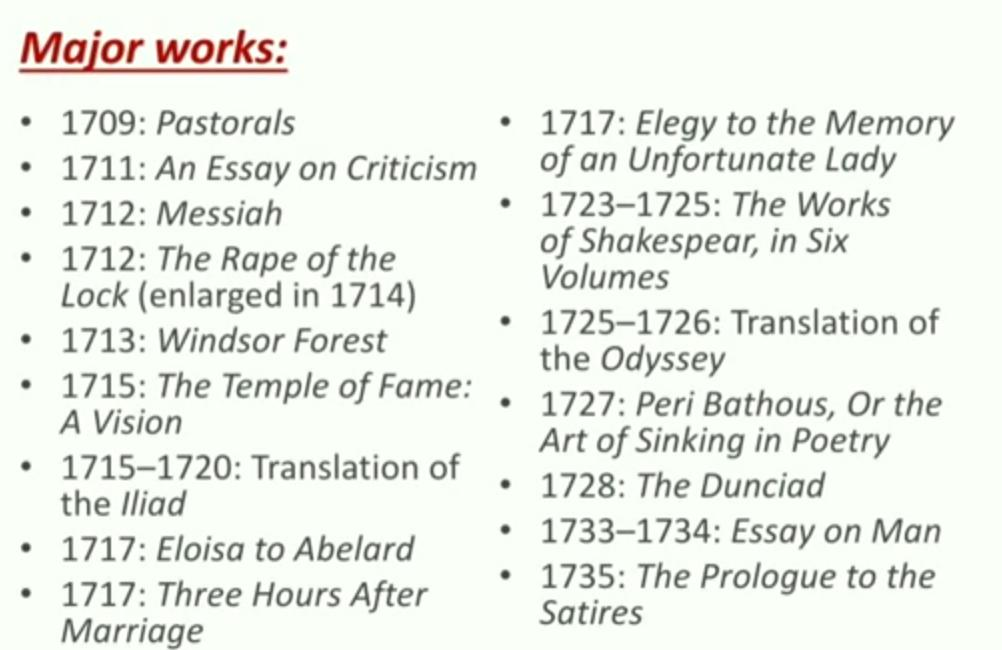
# Pope's Famous Works:

  • Pastorals:1709
  • An Essay on Criticism:1711
  • Messiah:1712
  • The Rape of The Lock:1712(enlarged in 1714)
  • Windsor Forest:1713
  • The Temple of Fame: a vision:1715
  • Three Hours After Marriage:1717
  • The Dunciad:1728
  • Essay on Man:1733-1734
  • Ode on Solitude:1700

At times during the last month of his life, he becomes delirious. Pope died on May 30, 1744, and was buried in Twickenham Church.

# Rape of The Lock

The Rape of The Lock

First published: In 1712 in Linto's Miscellaneous poem and Translations, then the final version was published in 1714.

The Meaning of Rape: Here "Rape" does not refer to "sexual rape". Here the word 'Rape' is derived from the Latin rapere which means "to snatch, to grab, to carry off".

Story Line: Based on a real-life incident in which a person called Lord Petre had cut off a lock of Arabella Fermor's hair without permission and thus created a breach between the two aristocratic Catholic families two.

The character of The Poem:

Belinda, The Baron, Caryl, Ariel, Umbriel.


1.) According to you, who is the protagonist of the poem Clarissa or Belinda? Why? Give your answer with logical reasons.

According to me, I see Belinda as the protagonist of the poem.


Belinda in "The Rape of The Lock" is an ambiguous character and the role played in the poem is also ambivalent. This paradox in the character of Belinda is explained by the fact that the pope looks upon her as a charming butterfly, an embodiment of physical beauty and of laudable qualities of head and heart and at the croquettes of the time and the butt of his social satire. There are times when even the praise of Belinda's attractions seems to be a mere mask for Pope's satiric attack on her, as the representative of her degenerate, unscrupulous class. One of Pope's contemporaries John Denies tried to undermine Belinda's character by saying that she is a chimera and not a character.

Belinda represents Miss Arabella Fermor of real life whom Lord Petre offended by stealing a lock of her hair. Pope wrote this poem to patch up the quarrel between the Fermors and Petres on a trivial matter. To achieve his objective he has to present Belinda as a good individual. He treats her satirically only when she represents the type of the pleasure-loving, unscrupulous and spineless aristocracy. The moralist in Pope aware of the decadence of values in the fashionable society and so he is critical of Belinda to the extent that she tries to follow all the decadent values of the society despite her natural beauty, youth, and charm. So the portrayal of Belinda is at once despicable and endearing.

"The Rape of the Lock" is a mock epic poem depicting a social drama of the 18th century fashionable society. Belinda is the main target of satire in the poem. She suffers from all the vanities, follies, and lack of moral scruples of the upper-class ladies of the time. She is a late riser, wakes up at twelve and falls asleep again, and is roused from her sleep by the licking tongue of her pet dog, Shock. When Belinda is engaged in her toilet, her beauty and charm are laid and stressed open. She is assisted by her servant Betty, in decorating and embellishing herself with cosmetics and with jewelry. She is here compared to a warrior as she dressed herself :

 "Now awful beauty puts all its arms; The fair each moment rises in her charms".

  She wears a sparkling cross, her looks are lively and she smiles at everyone but does not show any special favor towards anyone:

"Bright as the sun, her eyes the gazers strike And, like the sun, they shine on all alike".

 She has exquisite charm, Belinda is not only exceptionally beautiful but also the cause of joy and brightness in the world where she figures, Pope describes her as the "fair nymph", "virgin" and even a "Goddess".

Logical reason: Belinda is not only beautiful, but she is also keen to display her beauty. Her pleasure ride in a boat on the Thames is a part of this program. With her repaired smiles and artistically heightened and purified blush, Belinda is playing a role most of the time. Her role is that of an amiable beautiful maid who rejects without causing any offense and scatters her smiles on all, even at her grief after the snipping off the Lock of her hair, which is a studied art. As Pope puts in: 

"Then seen the nymph in beautious grief appears, Her eyes half-langu, half-drawned in tears".

2.) What is beauty? Write your views about it.

Beauty the word is a combination of different qualities. Like shape, color, and forms. but the point of view of seeing the beauty is different in all humans some see the aesthetic senses, especially sight. 

According to me, Beauty can be described as a feature that makes something look more pleasurable. In today's world, beauty has become a judging standard. However, one should realize that true beauty lies in the heart of the person. Beauty lies in the eyes of the beholder. Often, one thing that is looking attractive to us may not look beautiful to the other person. Hence, true beauty is not physical beauty. True beauty shows how beautiful the character of a person is. Inner beauty can touch the soul and make it feel joyful, there is a simple yet deep impact it can make over any person.


I also think that real beauty is our confidence which is make us more beautiful. and confidence is more important than looks. 


When Priyanka Chopra won the miss world she was not beautiful as the others so she asked to judge I am not beautiful like these other competitors so why still did you choose me? Judges told her that her confidence made her more beautiful. and that's why we give you this title.

Attraction is beauty. But money attraction is not a beauty. Looks and also personality attract us. And also the understanding with the person which one close to your heart and he or she understand your all your problems and all situations without telling anything to him or her this is a natural beauty.


Sometimes we see that many proposals of marriage were rejected by men because they want beautiful wives that judge girls by their beauty, not for their abilities. We have the best example of Fair and lovely this company changed its name to Glow and lovely because this advertise meant was hurt people's sentiments. Because in this advertisement they used the word Fair and also they saw in the advertisement that black skin girl was used the fair and lovely and his skin tone was changed. How can it be possible..?


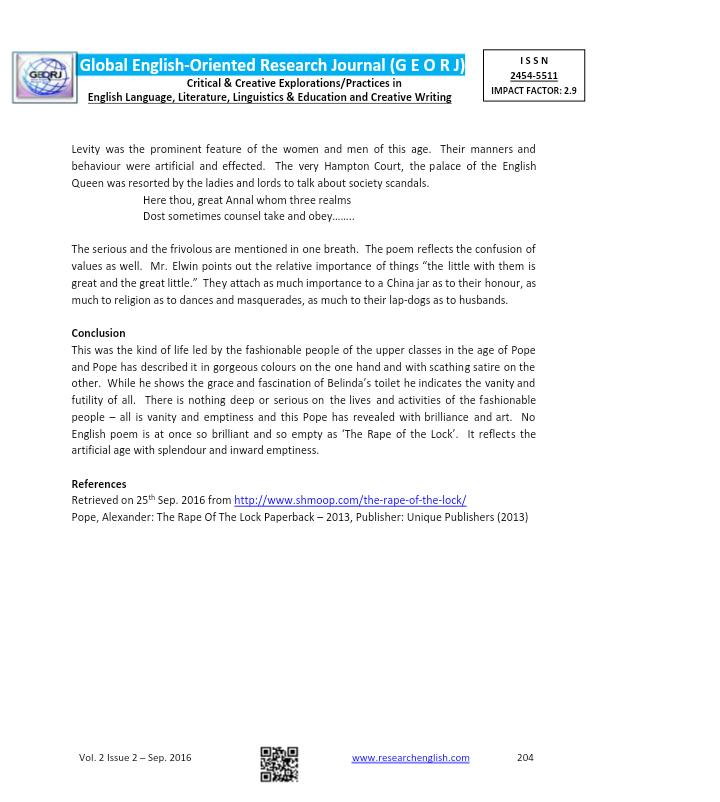
3.) Find out a research paper on "The Rape of the Lock". Give the details of the paper and write down in brief what it says about the Poem by Alexander Pope.


Alexander Pope has been the most representative poet of the eighteenth century. He is as representative of his age as Chaucer was of the late fourteenth century and Tennyson of the Victorian Age that his age is known as the Age of Pope speaks of the sovereign position in his age. His most representative poem 'The Rape of the Lock' faithfully mirrors at least a certain section of English society in the eighteenth century. It captures perfectly the ethos of the aristocratic society of the day. "No writer", says Leslie Stephen," reflects so clearly and completely the spirit of his own day as Pope does". And it is in the Rape of the Lock that he reflects the life of the fashionable aristocratic society of his time completely. The artificial tone of the age and the frivolous aspect of feminism are nowhere more exquisitely pictures than in this poem. It is the epic of trifling; a page torn from the petty, pleasure-seeking life of fashionable beauty.

4.) Write your views about the significance of hair. Is it symbolic?


Scholars, psychics, and beauty buffs agree the hair on your head makes you more pretty and powerful. Some cultures believe that hair is an extension of your spirit or soul..and your hair also connects you to the earth with its downward growth.


Hair symbolizes physical strength and virility; the virtues and properties of a person are said to be concentrated in his hair and nails. It is a symbol of instinct, female seduction, and physical attraction. Baldness may suggest sterility. Hair flowing depicts freedom and looseness; the unwilling removal of hair may be a castration symbol. Carries the context of magical power; witches had their hair shaven off, as well as in the Bible, in which Samson loses all his power when his locks are stripped. Heavy relations to fertility and even love the quantity is related to love potential.

 country wise and beauty wise people have different types and also different types of hair colors. Hair color carries symbols too:


golden- related to SUN symbolism

white - eternity

red- demoniacal, Satanic

violet -associated with goddesses

brown/black - chthonic forces

green - having to do with the sea, water

The tradition of giving a lock of hair to a loved one may not seem romantic now, but at one point, it was considered a token of affection. In fact, because hair does not decompose, it was cherished as a symbol of eternal life…a reminder of mortality, and immortality…a source of comfort.


Thank you for reading...

Macbeth

 MACBETH


 Hello readers, here I am going to write down my thinking activity and answer some questions. This blog is inspired by Dr. Dilip Barad sir. This blog on Shakespeare's play Macbeth.


Here, I am writing about the Writer of our tragedy Macbeth Mr. William Shakespeare.


Mr. William Shakespesre


"All the world's a stage, and all the men and women merely players. They have their exits and their entrances, and one man in his time plays many parts."


William Shakespeare was born in the town of Stratford-upon-Avon in Warwickshire, England, and baptized on 26 April 1564, according to the Parish register. His date of birth is popularly believed to be 23 April, but this is conjectural. Shakespeare’s mother, Mary Arden, was the daughter of a wealthy landowning farmer; his father, John Shakespeare, was a tradesman and an elected alderman. Scholars believe that Shakespeare was educated at King’s New School, the local grammar school. Shakespeare was taught Latin grammar and Latin classics.


A marriage license was issued to Shakespeare in 1582, recording his marriage to Anne Hathaway of a neighboring village. Six months later, Anne gave birth to their first daughter, Susanna. Two years later, twins, a son Hamnet and a daughter Judith were born to the couple. Hamnet died at the age of eleven. There is no extant record of Shakespeare's life during the years between the birth of the twins and his first appearance in London as a dramatist.


Shakespeare's Works: Though Shakespeare wrote several poems, the bulk of his work was drama. His plays cover a large variety of themes and plots, and display both his sensitivity to the world around him as well as his sharp, critical, and probing intelligence. Shakespeare wrote at least 38 plays and over 150 short and long poems.


Here I am putting the video of Shakespeare's Works:


"Tomorrow, and tomorrow, and tomorrow,

Creeps in this petty pace from day to day,

To the last syllable of recorded time;

And all our yesterdays have lighted fools

The way to dusty death. Out, out, brief candle!

Life's but a walking shadow, a poor player,

That struts and frets his hour upon the stage,

And then is heard no more. It is a tale

Told by an idiot, full of sound and fury,

Signifying nothing"


 Introduction of Play Macbeth

"Double, double toil and trouble;

Fire burns, and cauldron bubble”

 The extant text of Macbeth is, predictably enough, poorly preserved and bears evidence of several revisions. Most critics, however, agree that the play was written between 1603 and 1606. The Tragedie of Macbeth, in the First Folio of 1623. It was registered in the books of the Stationers Company on 8 November 1623 by Blount and Jaggard, the publishers of the folio, as one of the plays " not formerly entered to other men " 

Macbeth was also a real man, a king of 11th century Scotland who led a life filled with as much murder, treachery, and drama as the tragic hero. Three witches tell the Scottish general Macbeth that he will be King of Scotland. Encouraged by his wife, Macbeth kills the king, becomes the new king, and kills more people out of paranoia. The most important scene of Macbeth is the death of Lady Macbeth.


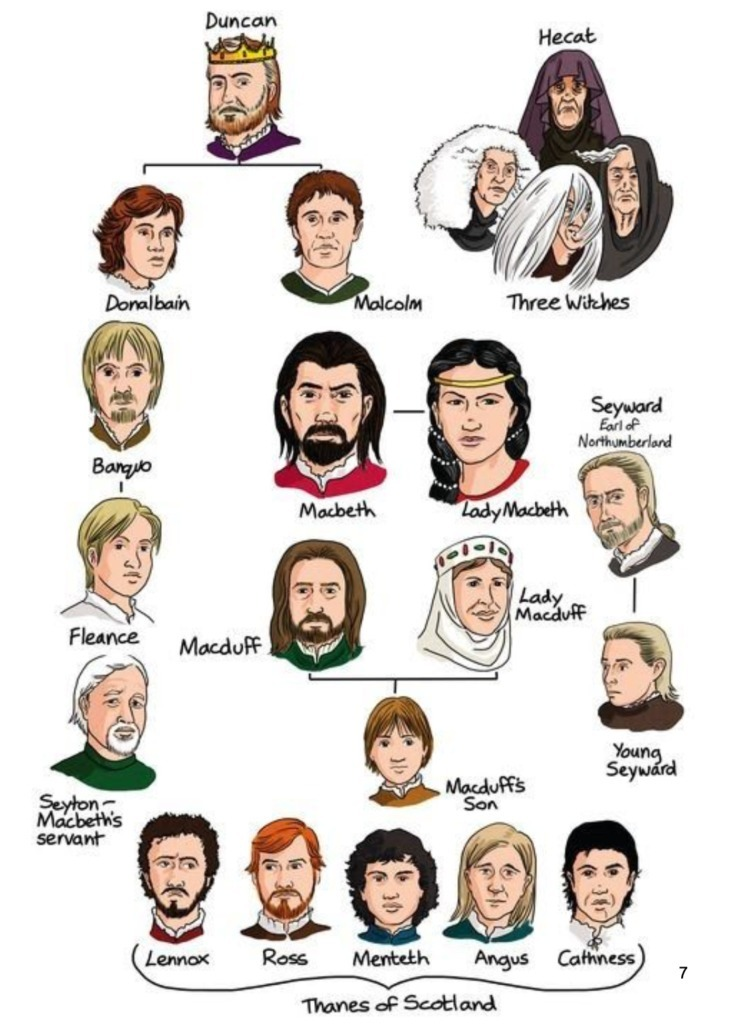
In Macbeth, there are many characters in the play. Macbeth, Lady Macbeth, Banquo, Duncan, The Three Witches, Macduff.

So I am putting here the picture of characters for better understanding.


"Nothing is but what is not."


Macbeth-


Macbeth is the title character of Shakespeare’s play Macbeth. He is the Scottish general who holds three successive titles in the play.

"Fair is foul, and foul is fair, hover through fog and filthy air"

First the Thane of Glaims, Thane of Cawdor, The king of Scotland. We find him as a tragic hero here in this play. His tragic flaw is Ambition where in he is willing to give everything for the crown.


Banquo- Banquo is Macbeth’s brave and noble best friend, as well as his second victim. Banquo enters the play with Macbeth after both have fought valiantly for Duncan’s side in a recent battle. In act lll, murderers kill Banquo at Macbeth’s command and try to kill his young son, Fleance, who manages to get away.


Duncan- Duncan is generous & noble & he is also grateful. Duncan praises Macbeth for the great courage and heroism in revolt and calls him a “noble kings man’’.


1) Feminist Reading of Lady Macbeth.


ANSWER:  Lady Macbeth-


In Shakespeare’s play Macbeth, he presents the conflicting character of Lady Macbeth. This character is indeed wonderful creation by Shakespeare. Lady Macbeth is shown as an iron-willed character willing to "I have given suck, and knowHow tender ’tis to love the babe that milks me.I would, while it was smiling in my face, Have plucked my nipple from my child’s boneless gums, And dash the brains out, had I so sworn as you Have done to this" to later being shown as possessed by nightmares of guilt how could such a strong character so quickly fall prey to uneasiness? According to materialist feminism theory, despite her earlier show of strength, Lady Macbeth’s eventual weakness is a result of a patriarchal portrayal of her gender. Macbeth is the wife of Macbeth. She is reduced to an insignificant person, who is haunted by hallucinations and she feels remorse and guilt. she is the victim of the patriarchy society.

"Come, thick night,
And pall thee in the dunnest smoke of hell,
That my keen knife see not the wound it makes,
Nor heaven peep through the blanket of the dark,
To cry, ‘Hold, hold!’"

Lady Macbeth’s support to advance her husband’s position within Scotland is clear from her entrance into the play. She agrees with the witches’ premonition and emphasizes the great things he can achieve if he only had the cruelty to commit the acts to achieve them. Lady  Macbeth’s first lines in the play do not consist of her own words, but her husband’s, which signals that her character’s primary motivations are invested towards her husband. She is first seen reading from a  letter that  Macbeth has sent her. Once she has finished reading the letter,  she immediately establishes that the witches’ premonitions will come true but also expresses her worries.

Lady Macbeth pivots from playing the role of a supportive wife in the conventional way of complimenting him, to using her support as a means of insulting Macbeth and emasculating him. Some critics called her a fourth witch because they believe that she is responsible for all evils. They also say that she told to Macbeth and commit him for the murder. She is also a fragile, beautiful, and highly intellectual woman. She does everything for her husband.


Here I am writing some good points about Lady Macbeth:


# Originally a good woman


  • She is a loving wife who is absorbed in the interest of her husband.

  • She is a tender-hearted woman.

  • She has to invoke the spirits to unsex her to enable her to murder the king.

  • Except on a few occasions she has kept her feminine nature throughout the play.

# An Ambitious Lady


  • Like her husband, she is also an ambitious lady
  • The only difference is that Macbeth is ambitious for himself and Lady Macbeth’s Ambition is not for herself but whatever she wishes and does, she does for her husband.

  • She wants him to wear the crown of Scotland.


# Her love for her husband


  • She loves him dearly and is beloved to him
  • It is for his ambition that she wants to unsex herself.

  • She knows that her husband is of weak will.

  • She supplements it with her strong will.

  • Lady Macbeth is not witched woman, she sacrifices herself for her husband.


# Her strength of will


  • The greater strength of will than her husband.

  • Once a decision to murder the king is taken, she remains firm to it and even persuades her husband not to waver from it.


# Her Resourcefulness


  • More resourceful than Macbeth 

  • She does not lose the balance of her mind even in most critical situations.

  • She has advised her husband instantly as the occasion needs.

  • She reads the unusual face of her husband who is going to murder King Duncan.

  • And immediately she advises him to “ look like an innocent flower and be the serpent under it”

  • She feigns to faint when the murder of Duncan is discovered.

  • She does so in order to divert the attention of the people from her husband.

  • She also controls the situation at the Banquet.


# A Conscientious Woman


  • In spite of all that she does in the play, we cannot say that she is not a conscientious woman.

  • She utters her distinct voice of remorse.

  • It is this sense of remorse that heightens the pathos and intensifies the tragic trait in the character of Lady Macbeth.

  • She is not essentially a bad woman.

  • She is an ideal wife.

  • She sacrifices her all to satisfy the ambition of her husband.

  • She becomes an accomplice in the murder.

  • She goes mad and ultimately commit suicide.


Thank you for Visiting...
[Words-1600]

Assignment on 110A

Assignment on From Page to Screen: Adaptation Studies on Chetan Bhagat's 'Five Point Someone' And '2 States' Name: Nira...