Wednesday, 29 March 2023

Assignment Paper number 106

Name: Nirali Madhabhai Dabhi

Batch: M.A Sem. 2 (2022-2024)

Enrollment Number: 4069206420220006

Roll Number: 13

Subject code: 22399

Paper Number: 106- The Twentieth Century Literature: 1900 to World War II

Email Address: niralidabhi95@gmail.com

Submit to: Smt S.B. Gardi, Department of English, M.K.B.U


Brief Introduction of Author:


T.S.Eliot


Thomas Stearns Eliot (1888-1965) was born in St. Louis, Missouri, of an old New England family. He was educated at Harvard and did graduate work in philosophy at the Sorbonne, Harvard, and Merton College, Oxford. He settled in England, where he was for a time a schoolmaster and a bank clerk, and eventually literary editor for the publishing house Faber & Faber, of which he later became a director. He founded and, during the seventeen years of its publication (1922-1939), edited the exclusive and influential literary journal Criterion. In 1927, Eliot became a British citizen and about the same time entered the Anglican Church.He won the Nobel Prize for Literature in 1948; from then until his death he achieved public admiration unequalled by any other 20th-century poet.


Introduction of Poem:


"The Waste Land" is a poem by T.S. Eliot, first published in 1922. It is considered one of the most important and influential poems of the 20th century. The poem is known for its complex structure, its use of multiple voices and languages, and its exploration of themes of disillusionment, fragmentation, and despair in the aftermath of World War I. In this thematic study, I will examine some of the major themes in "The Waste Land" and how they contribute to the overall meaning of the poem.


Themes:


  1. Life in Death and Death in Life

  2. Sexual perversion

  3. Loss of faith and moral values

  4. Lack of human relationships

  5. Death

  6. Rebirth

  7. The Seasons

  8. Lust

  9. Water

  10. History


The critics have commented on the theme in different words: "vision of desolation and spiritual drought" (F. R. Leavis); "the plight of the whole generation" (I. A. Richards).


  1. Life in Death and Death in Life

Eliot has stated the matter quite explicitly in one of his essays. In his ‘Baudelaire’ he says: ‘I think, that Baudelaire has perceived that what distinguishes the relations of man and woman from the copulation of beasts is the knowledge of God and Evil (of moral Good and Evil which are not natural Good and Bad or puritan Right and Wrong). Having an imperfect, vague romantic conception of Good, he was at least able to understand that the sexual act as evil is more dignified, less boring, than as the natural, ‘life-giving’, cherry automatism of the modern world … So far as we are human, what we do must be either evil or good; so far as we do evil or good, we are human; and it is better, in a paradoxical way, to do evil than to do nothing: at least, we exist.’

 The last statement is highly important for an understanding of The Waste Land. The fact that men have lost knowledge of good and evil, keeps them from being alive, and is the justification for viewing the modern waste land as a realm in which the inhabitants do not even exist.

This theme is stated in the quotation which prefaces the poem.

"Nam Sibyllam quidem Cumis ego ipse oculis meis

vidi in ampulla pendere, et cum illi pueri dicerent:

Sibylla ti theleis; respondebat illa: apothanein thelo."


This is life-in-death, a life of complete inactivity, listlessness and apathy. That is why winter is welcome to them and April is the cruellest of months, for it reminds them of the stirring of life and, they dislike to be roused from their death-in-life.

April is the cruellest month, breeding

Lilacs out of the dead land, mixing

Memory and desire, stirring

Dull roots with spring rain.

Winter kept us warm, covering

Earth in forgetful snow, feeding

A little life with dried tubers.


The Waste Land is primarily regarded as a poem that epitomises the chaotic life of both individuals and society in the twentieth century. Thematically, it reflects the disillusionment and despair of the post World War I generation. 


  1. Sexual perversion

According to Eliot, sex is an important aspect of life. It is an expression of love and means of procreation. Today, sex has been perverted from its proper function and is utilised for animal pleasure and monetary benefits. It has, therefore, become a source of degeneration and disease. It has also led to the erosion of moral values and become a hurdle in man's spiritual progress. Easy sexual relationships are found in all sections of the society. Eliot cites the instance of a German princess in the first part of the poem. This is the parallel to the love affairs of Queen Elizabeth with the Earl of Leicester in the Tudor period. There is also another instance of freedom of sex in high society. Eliot mentions it in the career of the lady of the situation. In the second part of the poem, the perversion of sex, prevails among the lower access of society. Eliot mentions the story of Lil and the experience of three daug relationships between the typist girl and her boyfriend. In the poem, three daughters of Thames. Another example is that of mechanical sex another example is a homosexual relationship exemplified by Mr. Eugenides. Eliot sums up the story of European lust through the line of The Fire Sermon:

"To Carthage then I came

Burning burning burning burning"

He means that the whole of Europe is being destroyed by the fire of sexuality.


  1. Loss of faith and moral values

In ancient times, the source of inspiration for life and achievement was faith. People really believed in Christian values. Tradition increases the importance of moral conduct. Elderly people were respected. Character and saintliness were regarded as important assets. Moreover, more important than money and position were character and achievement. Today the values have changed. Money is the god of modern people. Older people are hated. Christians go to the church as a matter of routine. There is a gulf between profession and practice. Hypocrisy is at a premium. Flattery is more important than merit. The result is that Christian faith and compassion are no longer regarded as objects of life. This has resulted in general deterioration of standard of life and yard-sticks of reputation:


"And upside down in air were towers

Tolling reminiscent bells, that kept the hours

And voices singing out of empty cisterns and exhausted wells."


  1. Lack of human relationships

In older times, people believed in intimate human relationships. There was the joint family system, under which resources were cooled and the needs of all were supplied. Today there is the fashion of nocular families. In olden times there were certain loyalties to the community and loyalty to the nation. Such loyalties no longer exist. People have become self-centred and egoistic. There is no sentiment of sympathy and compassion for the members of distant families and the community. Each one thinks only of his own interest and how he can gain at the expense of others. Exploitation is the order of the day. Eliot mentions it in the last Section. As the poet feels that we are like Coriolanus and the embodiment of selfishness. Each one is imprisoned in his own self. We have lost the key to human sympathy and brotherhood:


"We think of the key, each in his prison

Thinking of the key, each confirms a prison"


  1. Death

Two of the poem’s sections -- “The Burial of the Dead” and “Death by Water” --refer specifically to this theme. What complicates matters is that death can mean life; in other words, by dying, a being can pave the way for new lives. Eliot asks his friend Stetson: “That corpse you planted last year in your garden, / Has it begun to sprout? Will it bloom this year?” Similarly, Christ, by “dying,” redeemed humanity and thereby gave new life. The ambiguous passage between life and death finds an echo in the frequent allusions to Dante, particularly in the Limbo-like vision of the men flowing across London Bridge and through the modern city.


  1. Rebirth

The Christ images in the poem, along with the many other religious metaphors, posit rebirth and resurrection as central themes. The Waste Land lies fallow and the Fisher King is impotent; what is needed is a new beginning. Water, for one, can bring about that rebirth, but it can also destroy. What the poet must finally turn to is Heaven, in the climactic exchange with the skies: “Datta. Dayadhvam. Damyata.” Eliot’s vision is essentially of a world that is neither dying nor living; to break the spell, a profound change, perhaps an ineffable one, is required. Hence the prevalence of Grail imagery in the poem; that holy chalice can restore life and wipe the slate clean; likewise, Eliot refers frequently to baptisms and to rivers – both “life-givers,” in either spiritual or physical ways.


  1. The Season

"The Waste Land" opens with an invocation of April, “the cruellest month.” That spring be depicted as cruel is a curious choice on Eliot’s part, but as a paradox it informs the rest of the poem to a great degree. What brings life brings also death; the seasons fluctuate, spinning from one state to another, but, like history, they maintain some sort of stasis; not everything changes. In the end, Eliot’s “waste land” is almost seasonless: devoid of rain, of propagation, of real change. The world hangs in a perpetual limbo, awaiting the dawn of a new season.


  1. Lust

Perhaps the most famous episode in "The Waste Land" involves a female typist’s liaison with a “carbuncular” man. Eliot depicts the scene as something akin to a rape. This chance sexual encounter carries with it mythological baggage – the violated Philomela, the blind Tiresias who lived for a time as a woman. Sexuality runs through "The Waste Land," taking center stage as a cause of calamity in “The Fire Sermon.” Nonetheless, Eliot defends “a moment’s surrender” as a part of existence in “What the Thunder Said.” Lust may be a sin, and sex may be too easy and too rampant in Eliot’s London, but action is still preferable to inaction. What is needed is sex that produces life, that rejuvenates, that restores – sex, in other words, that is not “sterile.”


  1. Water

"The Waste Land" lacks water; water promises rebirth. At the same time, however, water can bring about death. Eliot sees the card of the drowned Phoenician sailor and later titles the fourth section of his poem after Madame Sosostris’ mandate that he fear “death by water.” When the rain finally arrives at the close of the poem, it does suggest the cleansing of sins, the washing away of misdeeds, and the start of a new future; however, with it comes thunder, and therefore perhaps lightning. The latter may portend fire; thus, “The Fire Sermon” and “What the Thunder Said” are not so far removed in imagery, linked by the potentially harmful forces of nature.


  1. History

History, Eliot suggests, is a repeating cycle. When he calls Stetson, the Punic War stands in for World War I; this substitution is crucial because it is shocking. At the time Eliot wrote "The Waste Land," the First World War was definitely a first - the "Great War" for those who had witnessed it. There had been none to compare with it in history. The predominant sensibility was one of profound change; the world had been turned upside down and now, with the rapid progress of technology, the movements of societies, and the radical upheavals in the arts, sciences, and philosophy, the history of mankind had reached a turning point.


Eliot revises this thesis, arguing that the more things change the more they stay the same. He links a sordid affair between a typist and a young man to Sophocles via the figure of Tiresias; he replaces a line from Marvell’s “To His Coy Mistress” with “the sound of horns and motors”; he invokes Dante upon the modern-day London Bridge, bustling with commuter traffic; he notices the Ionian columns of a bar on Lower Thames Street teeming with fishermen. The ancient nestles against the mediaeval, rubs shoulders with the Renaissance, and crosses paths with the centuries to follow. History becomes a blur. Eliot’s poem is like a street in Rome or Athens; one layer of history upon another upon another.


(Word count-2060)


Assignment Paper number 108

 Name: Nirali Madhabhai Dabhi

Batch: M.A Sem. 2 (2022-2024)

Enrollment Number: 4069206420220006

Roll Number: 13

Subject code: 22401

Paper Number: 108- The American Literature 

Email Address: niralidabhi95@gmail.com

Submit to: Smt S.B. Gardi, Department of English, M.K.B.U


Comparing and contrasting Bob Dylan and Bruce Springsteen


Introduction of Bob Dylan:


Bob Dylan is a legendary American singer-songwriter, poet, and visual artist who was born on May 24, 1941, in Duluth, Minnesota. He rose to fame in the 1960s as a leading figure in the American folk music revival, and his music has had a profound influence on popular culture and the political landscape.


Dylan started his musical career in coffeehouses in Greenwich Village, New York City, where he developed a reputation for his thoughtful lyrics and distinctive vocal style. His early albums, such as "The Freewheelin' Bob Dylan" and "The Times They Are a-Changin'," were heavily influenced by the Civil Rights Movement and the anti-war movement, and he became known as the "voice of a generation."


Throughout his career, Dylan has explored a wide range of musical styles, from folk and blues to rock and roll and country. He has also been known for his experimentation with electric instruments, which caused controversy among his fans and the music industry in the 1960s.


Dylan's music has been recognized with numerous awards, including 10 Grammy Awards, a Golden Globe, and an Academy Award. In 2016, he was awarded the Nobel Prize in Literature "for having created new poetic expressions within the great American song tradition."


Beyond his music, Dylan is also a visual artist, with his artwork exhibited in galleries around the world. He has published several books, including the memoir "Chronicles: Volume One," which was released in 2004.


Throughout his career, Dylan has continued to inspire generations of musicians and fans with his unique voice, poetic lyrics, and social consciousness. He remains one of the most important and influential figures in American music history.


Introduction of Bruce Springsteen


Bruce Springsteen is an American singer-songwriter, musician, and producer born on September 23, 1949, in Long Branch, New Jersey. He is known for his distinctively raspy voice, his high-energy live performances, and his deeply personal and often politically charged lyrics.


Springsteen's music is characterized by its rock and roll sound, which is often accompanied by powerful and memorable lyrics that explore themes of working-class life, social justice, and the American Dream. He rose to fame in the 1970s with his third album, "Born to Run," which was a commercial and critical success and helped establish him as one of the most important musicians of his generation.


Throughout his career, Springsteen has released a number of iconic albums, including "The River," "Born in the U.S.A.," and "Darkness on the Edge of Town." He has won numerous awards, including 20 Grammy Awards, an Academy Award, and a Tony Award for his Broadway show "Springsteen on Broadway."


Beyond his music, Springsteen is also a philanthropist and activist. He has been involved in a number of social justice causes, including workers' rights and ending gun violence, and has used his music to raise awareness and support for these issues.


Springsteen's music continues to inspire generations of fans and musicians, and his live shows are legendary for their energy and intensity. He remains one of the most important and influential figures in American music history.


Musical Style


Bob Dylan and Bruce Springsteen are both known for their contributions to American music, but their musical styles are quite different.


Bob Dylan's early music was heavily influenced by folk music and blues, which he picked up during his time playing in coffeehouses in Greenwich Village in the early 1960s. His early albums, such as "The Freewheelin' Bob Dylan" and "The Times They Are a-Changin'," featured acoustic guitars and harmonicas, and his lyrics often dealt with social and political issues. However, Dylan's music later evolved to include elements of rock and roll and electric instruments, such as on his landmark album "Highway 61 Revisited" and the controversial "Blonde on Blonde." Overall, Dylan's music is characterized by his distinctive, nasal voice, poetic lyrics, and eclectic blend of musical styles.


Bruce Springsteen's music is more rooted in rock and roll, with elements of folk, soul, and R&B mixed in. His early albums, such as "Greetings from Asbury Park, N.J." and "The Wild, the Innocent & the E Street Shuffle," featured a raw, energetic sound, with Springsteen's lyrics often telling stories of working-class life and the struggles of the American Dream. As his career progressed, Springsteen's sound became more polished and produced, with albums like "Born in the U.S.A." featuring big, anthemic rock songs. Overall, Springsteen's music is characterized by his gravelly voice, passionate delivery, and ability to capture the essence of the American experience in his lyrics.


While both Dylan and Springsteen are often classified as rock musicians, their musical styles are distinct and reflect their individual influences and approaches to songwriting.


Lyrics and storytelling 


Bob Dylan and Bruce Springsteen are known for their ability to tell compelling stories through their lyrics. Let's take a closer look at their individual approaches to lyrics and storytelling:


Bob Dylan's lyrics are often characterized by their poetic and enigmatic quality. He has been known to employ surrealistic and metaphorical language, which can be difficult to decipher at times. Many of his early songs, such as "Blowin' in the Wind" and "The Times They Are a-Changin'," dealt with social and political issues of the time, while others, like "Mr. Tambourine Man" and "Tangled Up in Blue," explore personal themes and relationships. Dylan's lyrics often feature themes of protest, social injustice, and love, but they are often open to interpretation, leaving listeners to draw their own conclusions about their meaning.


Bruce Springsteen's lyrics, on the other hand, are often more direct and narrative-driven. His songs frequently tell stories of working-class life and the struggles of ordinary people, often inspired by his own experiences growing up in New Jersey. Songs like "Born to Run," "Thunder Road," and "The River" are anthems of youthful rebellion and escape, while others, like "Atlantic City" and "The Ghost of Tom Joad," offer critiques of the American Dream and the plight of the working poor. Springsteen's lyrics are often characterized by their vivid imagery and emotional intensity, and he is known for his ability to capture the essence of the American experience in his songs.


While Dylan's lyrics are often more abstract and open to interpretation, Springsteen's are more grounded in narrative storytelling. However, both artists share a commitment to exploring important social and cultural themes through their music. Whether they are singing about love, politics, or the struggles of everyday life, Dylan and Springsteen are masters of using their lyrics to create powerful stories that resonate with listeners.


Comparing and contrasting 


Bob Dylan and Bruce Springsteen are two of the most iconic and influential American musicians of the 20th century. While they share certain similarities in terms of their musical styles and political themes, there are also distinct differences in their approach to songwriting, performance, and cultural impact. In this essay, we will compare and contrast the careers of Bob Dylan and Bruce Springsteen.


Firstly, let us examine their musical styles. Both Dylan and Springsteen are known for their distinct voices and unique songwriting abilities. Dylan is often credited with revolutionizing folk music in the 1960s with his socially conscious lyrics and distinctive vocal style. He is also known for his use of poetic language and intricate storytelling in his songs. In contrast, Springsteen is associated with a more rock and roll sound, characterized by driving rhythms, soaring guitar solos, and anthemic choruses. His music often features working-class themes, and he is known for his high-energy live performances.


In terms of political themes, both Dylan and Springsteen have used their music as a platform to express their views on social justice and political activism. Dylan's early music was heavily influenced by the Civil Rights Movement and the anti-war movement, and his songs often dealt with themes of social inequality and injustice. Springsteen, on the other hand, has been vocal about his support for workers' rights and economic equality. Many of his songs deal with the struggles of the working class and the impact of economic inequality on American society.


Another important difference between Dylan and Springsteen is their cultural impact. Dylan is widely regarded as one of the most important and influential musicians of the 20th century, with a career that spans over six decades. He has been recognized with numerous awards, including the Nobel Prize in Literature in 2016. Springsteen, while also highly acclaimed, has had a more limited impact on popular culture. However, his influence can be seen in the work of many contemporary musicians who have been inspired by his unique style and social activism.


In terms of their approach to performance, there are also notable differences between Dylan and Springsteen. Dylan is known for his introspective and often understated performances, preferring to let his lyrics speak for themselves. Springsteen, on the other hand, is famous for his high-energy live shows, which often feature elaborate stage sets and theatrical performances.


Songs of both Bob Dylan and Bruce Springsteen


Bob Dylan and Bruce Springsteen are both highly regarded for their extensive catalogs of memorable and influential songs. Let's take a closer look at some of their most iconic songs:


Bob Dylan:


"Blowin' in the Wind": One of Dylan's most famous protest songs, "Blowin' in the Wind" was a major hit in the early 1960s and became an anthem of the civil rights movement.

"Like a Rolling Stone": A six-minute epic that redefined the possibilities of pop music, "Like a Rolling Stone" is considered one of Dylan's greatest achievements and a landmark of the rock era.

"Tangled Up in Blue": A complex, multi-layered song that reflects on a failed relationship, "Tangled Up in Blue" is widely regarded as one of Dylan's greatest compositions.

"Mr. Tambourine Man": A psychedelic-tinged classic that celebrates the power of music and imagination, "Mr. Tambourine Man" has been covered by countless artists over the years and remains a beloved song to this day.

"The Times They Are a-Changin'": Another of Dylan's most famous protest songs, "The Times They Are a-Changin'" is a stirring call to arms for social justice and political change.


Bruce Springsteen:


"Born to Run": An epic ode to youthful rebellion and escape, "Born to Run" is one of Springsteen's most iconic songs and a cornerstone of his live shows.

"Thunder Road": A cinematic, romantic ballad that tells the story of a young couple trying to escape their dead-end lives, "Thunder Road" is considered one of Springsteen's greatest songs.

"The River": A powerful reflection on the struggles of working-class life and the loss of youthful dreams, "The River" is a haunting and emotional masterpiece.

"Dancing in the Dark": A propulsive, synth-driven pop song that became one of Springsteen's biggest hits, "Dancing in the Dark" is an irresistible party anthem.

"Born in the USA": A scathing critique of American society and the treatment of veterans, "Born in the USA" is often misinterpreted as a patriotic anthem, but is actually a deeply political song.


Both Bob Dylan and Bruce Springsteen have written countless other iconic songs, but these examples give a sense of their individual styles and themes. Dylan's songs are often poetic and enigmatic, while Springsteen's are more narrative-driven and grounded in everyday life. Both artists have made important contributions to the history of popular music, and their songs continue to inspire and resonate with listeners today


Conclusion


While Bob Dylan and Bruce Springsteen share certain similarities in terms of their political themes and commitment to social justice, they also have distinct differences in their musical styles, cultural impact, and approach to performance. Both musicians have had a significant impact on American music and culture, and their legacies continue to influence artists around the world today.


(Word count- 1990)


Assignment Paper Number 107

Name: Nirali Madhabhai Dabhi

Batch: M.A Sem. 2 (2022-2024)

Enrollment Number: 4069206420220006

Roll Number: 13

Subject code: 22400

Paper Number: 107- The Twentieth Century Literature: 1900 to World War II to the End of the Century 

Email Address: niralidabhi95@gmail.com

Submit to: Smt S.B. Gardi, Department of English, M.K.B.U


Orwellian Parallels in Modern India


Brief Introduction of the author: 


George Orwell


George Orwell was the pen name of Eric Arthur Blair, a British writer and journalist born on June 25, 1903. He is best known for his works of dystopian fiction, including "Animal Farm" and "Nineteen Eighty-Four," which continue to be widely read and studied today. Orwell's experiences in the Spanish Civil War deeply influenced his writing. He died in 1950 at the age of 46 from tuberculosis, but his work remains highly influential in fields such as political science, literature, and journalism.


George Orwell's 1984 is a dystopian novel that depicts a society under constant surveillance under an authoritarian regime. To restrict people's freedom of speech, the government even imposes a new language: 'Newspeak.' In Orwell's valley of fear, the ruling party, Ingsoc, has created a world where every individual is simultaneously watching and being watched through a series of telescreens set up in every nook and corner of the cities. In this society, thinking of ideas that defy the rhetoric of the ruling party is considered a criminal offense, referred to as 'thoughtcrime.' Although our society has not yet found ways to criminalize thoughts, Orwell's fictional depiction of the future world is eerily coming true. The Logical Indian decodes George Orwell's 1984 in an uncanny depiction of the world we are living in today.


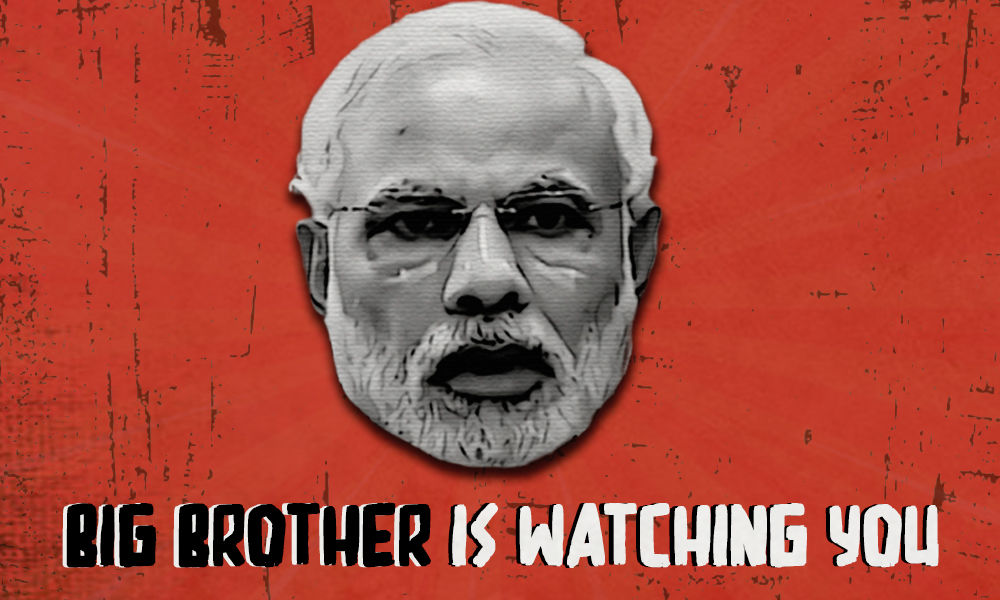
Big Brother Is Watching You


1984 - The citizens of the dystopian country, Oceania, are constantly being watched through telescreens, their every step is monitored. The Party says that this surveillance is for the greater good of the country. Those who violate the Party's rules are labelled as 'traitors' and they are eventually 'vapourised.' The people of Oceania always see Big Brother's face plastered on posters on the streets, on their telescreens and stamped onto the coins - a constant reminder that they are being watched. 


In India - The world is moving into the Orwellian era where every movement is being monitored - not only bodily movements but the likes and dislikes of an individual. Internet freedom declined in India—the result of an increase in arrests for online activity and continued internet shutdowns during times of perceived unrest. In its 2017 response to a Right to Information (RTI) request, the Ministry of Electronics and Information Technology confirmed that as many as 23,030 websites or URLs had been blocked. In another acknowledgment reflecting the scale of government blocking, the DoT confirmed in August 2018 that it had requested the blocking of 11,045 websites, webpages, and URLs since 2016. Some of the content that has been blocked includes social media networking groups and websites engaged in flaring up "anti-India" sentiments. Controversies also continued around Aadhaar, the world's largest biometric identification system and a problematic draft data protection bill remains in limbo. Meanwhile, ahead of the 2019 elections, incumbents and candidates manipulated content, used bots and employed volunteers to push inorganic content and exacerbate existing social tensions for political gain. Within this environment, marginalized groups, in particular, experienced online harassment and trolling. The Supreme Court ruled in September 2018 that the government's controversial biometric Aadhaar project is constitutional but set limits on the program's use. In March 2019, despite the court's restrictions, the government promulgated the Aadhaar Ordinance, allowing for the voluntary linking of Aadhaar numbers for commercial use. Local authorities continue to restrict connectivity routinely in India justifying shutdowns on the basis of protests, misinformation, exams and to maintain public order, among other things.


The 'Child Spies'


1984 - The child-spies are an important component of the Big Brother system that monitors the thoughts and activities of the citizens. Orwell writes that the children "were systematically turned against their parents and taught to spy on them and report their deviations." The motivation for the children to give up on their parents was being rewarded by public acknowledgement, being hailed as heroes. 


In India- In an uncomfortably similar scenario, a disturbing video surfaced in December 2019 amidst the anti-CAA protests where some children could be seen donning BJP caps, joyously walking and chanting slogans such as "Desh ke gaddaro ko, goli maaro saalo ko!" and "Aatankwadi ki kya pehchan? Mulla, Masjid, Pakistan!" Hatred breeds more hatred. Children - the future of our country - should be protected from vile and hate, for their sake and the sake of the country.


Thought Police 


1984 - The most terrifying part of the book is that one couldn't keep Big Brother out of one's head. The real goal of Orwell's authoritarians in 1984 is to control the grey matter between the ears. The Thought Police use psychological warfare and false-flag operations to entrap free thinkers or nonconformists and proceed to 'vaporise' or remove them from existence. In a sense, 1984 is largely a book about humans trying to hold onto the truth in the face of propaganda and power. 


In India- The rise in Modi fanfare overlaps with an exponential rise in the use of social media in India, a medium that this government has exploited over and over to mobilise public opinion, and use tags like "anti-national" to discredit anyone questioning the state narrative. Speaking about the thought police, one can't help but mention the recent acts of Delhi police. On 5th January, masked goons entered the Jawaharlal Nehru University campus with sticks and rods, beat-up the students and left — all under the watch of Delhi Police. Dozens of goons, with their faces covered with mufflers, chanted slogans — "Desh ke gaddaro ko, goli maaro saalon ko," went so far as to not allow ambulances to reach the campus by puncturing tyres and smashing windows. And yet, all of this happened next to a police barricade and in front of a police detention van. The police's words and actions in the following days have been questionable.

After being overpowered by police personnel, Kapil had chanted "Jai Shri Ram" and said, "hamare desh me aur kisi ki nahi chalegi, sirf Hinduon ki chalegi [only Hindus shall have a say in our country, no one else]," as he was taken into custody by the Delhi Police. Bhim Army chief, Chandrashekhar Azad, was sent to 14 days' judicial custody a day after he led a massive protest against the Citizenship Amendment Act in Old Delhi.


Ministry of Truth 


1984 - As with the names of the other ministries in Oceania, the name Ministry of Truth means the exact opposite of what it says. The Ministry of Truth is where lies are manufactured. Winston Smith, the protagonist, works here, rewriting old news articles to reflect the Party's latest version of reality and throwing the old articles down a "memory hole" where they are incinerated. The Ministry of Truth reflects the Party's belief that power is the only truth and that those with power can alter the "truth" into whatever they choose. 


In India- Winston's job finds relevance in real life in the form of fake news. The Economic Times declared 2019 as the year of Fake News. The menace has chased us into 2020 as well. India has the largest number of social media users in the world across platforms such as Facebook, YouTube, Instagram, WhatsApp, ShareChat, TikTok, etc. Fake stories, rumours and hate speech spread through social media have been connected to various incidents of mob attacks and lynching in the country. News is almost instantly available and shareable at the tap of a button. Anyone with internet access can develop a blog or can produce a video without fact-checking or an editorial process of any kind. Stories that expose or ridicule conduct, doctrines, or institutions either by direct criticism or more often through irony, parody or caricature try to influence public opinion on a person, a policy, an event or another news story. In recent years, there has been a resurgence of both false and misleading, highly opinionated articles on the web that are passed off as news.


Two Minutes Hate 


1984 - "The horrible thing about the Two Minutes Hate was not that one was obliged to act a part, but, on the contrary, that it was impossible to avoid joining in." The Two Minutes Hate is a ritual observance that is designed to use the collective rage of the people against supposed "enemies of the Party" to strengthen the Party's position among the people. The ritual serves to unify the people in the observance of the ritual. Because Big Brother is proclaimed to be benevolent and good, any enemy is automatically evil and bad. While it is a "Two Minutes Hate" the desired end result is less hatred of Big Brother. Ever noticed how viral outrage regularly rips through social media? It's usually over just as quickly as it comes.


In India- BJP's preference for Hate Speech is increasingly becoming apparent. Even Mahatma Gandhi is not spared. Referring to Gandhi, BJP MP from Karnataka, Anant Kumar Hegde, questioned the freedom movement led by the Father of the Nation and described India's independence struggle as an "adjustment" with the then British rulers. Breaching traditional norms in public utterances is clearly the "new normal" in the BJP with Union Minister Prakash Javdekar labelling Delhi Chief Minister Arvind Kejriwal a "terrorist." Simultaneously, Uttar Pradesh Chief Minister Yogi Adityanath stuck to the "tukde-tukde gang (secessionist forces, a term now routinely used for opposition parties by BJP leaders)" narrative in his various public meetings in the run-up to the Delhi Assembly polls.


Doublethink 


1984 - 'Doublethink' is a concept explained in the book as: "The power of holding two contradictory beliefs in one's mind simultaneously and accepting both of them… To tell deliberate lies while genuinely believing in them, to forget any fact that has become inconvenient, and then, when it becomes necessary again, to draw it back from oblivion for just as long as it is needed, to deny the existence of objective reality and all the while to take account of the reality which one denies – all this is indispensably necessary." 


In India - It is not uncommon today for politicians to make promises during election campaigns but not bother to keep these promises once they are elected to power. Recently, a case was filed by an advocate at the state high court, HK Singh, against Narendra Modi and Amit Shah for cheating people by promising them that ₹15 lakh would be credited to each person's bank account if the BJP came to power in the 2014 Lok Sabha polls. In her Union Budget 2020 speech, Finance Minister Nirmala Sitharaman said that data must have strong credibility to combat the difficulties of real-time monitoring in the Indian economy, adding that the phrase "data is the new oil" has now become a cliché. Sitharaman proposed a policy to increase focus on credible data-driven analysis, under private sectors, building data centre parks throughout the country. Contrasting the finance minister's ambitious claims, the budget documents were found with multiple discrepancies, which the ministry later denied.


Conclusion


In 1946, Observer editor, David Astor, lent George Orwell a remote Scottish farmhouse in which he wrote his new book, Nineteen Eighty-Four. It became one of the most significant novels of the 20th century. So just like Winston, we still live in a constant state of uncertainty. We live in fear of being controlled, we dread surveillance and we are afraid of our dissent being crushed. The circumstances surrounding the writing of Nineteen Eighty-Four make a haunting narrative. The spine-chilling similarities with modern times describe the curtailment of freedom in the real world by politicians and officials - alarmingly, nowhere and never more often than in India.


(Word count- 1974)


Tuesday, 28 March 2023

Thinking activity : Indian Poetics

Welcome to my Blog,

This blog is part of our study. This Thinking activity is based on Indian Poetics and was assigned by Dr. Dilip Barad sir Department of English MKBU. In this task, we have to Write about various schools like Rasa, Dhvani, Auchitya, Vakrokti, Riti, and alankaar based on our understanding of these concepts. And also Give examples from Gujarati, Hindi, Sanskrit, and English literature.

Indian Poetics


Dr. Dilip Barad Sir Department of English, MKBU Organized the expert Lecture Of Dr. Vinod Joshi's Lecture to teach us Indian aesthetics. He is a  Gujarati writer, Poet, Critic, and professor.

Prof. Vinod Joshi was invited to the session for the week. From 5 January to 13 January, He talks about the Different About Schools of Indian Poetics.

  • Rasa
  • Riti
  • Vakrokti   
  • Dhvani
  • Auchitya
  • Alankara

First of all, we have to understand the concept of Indian Poetics.

What is Indian Poetics?

Indian Poetics has Developed in India a thousand years ago. Indian poetics refers to the study of the artistic and literary traditions of the Indian subcontinent, including the theories and practices of poetry, drama, and literary criticism. It encompasses a rich and diverse tradition that dates back thousands of years, encompassing Sanskrit, Prakrit, and regional language literature, as well as the critical discourse surrounding these works.

One of the central texts of Indian poetics is the "Natyashastra," a Sanskrit treatise on drama and aesthetics that dates back to the 2nd century BCE. This text outlines the principles of poetics and lays down the foundations of Indian dramatic theory, including the use of characterization, plot, song, and dance.


Indian poetics is also characterized by the "Rasa" theory, which holds that poetry and drama can evoke a range of emotional responses or "flavors" in the reader or viewer. These emotions, or "rasas," include feelings of love, wonder, heroism, and disgust, among others. Indian poetics is a rich and multifaceted tradition that has deeply influenced the development of literature and the arts in the Indian subcontinent and continues to shape the understanding and appreciation of these works to this day.

The Six Schools:-

  1. Rasa - Bharat
  2. Alamkara - Bhamaha
  3. Riti - Vamana
  4. Dhvani - Anandvardhan
  5. Vakrokti - Kuntaka
  6. Auchitya - Kemendra

1. Rasa:-

Bharat muni believes that the dramatic form of aesthetic experience is the most perfect fruition of aesthetic activity because drama is the synthesis of all arts According to Abhinav Gupta who was one of the famous critics of Natyashastra, Rasa is the simplest and most we bewildering expression in the Sanskrit language. Anyone can experience it but needs help to define it precisely.

According to Bharat muni the realization of Rasa results from the Union of Vibhavas, Anubhavas, and Vyabhikaribhavas. When Sthaibhavas unite with others, the three Bhavas, one attains the quality of Rasa.

Nine Rasas by Bharat muni in his Natyashastra.


Sthayibhav                              Rasa

1. શમ/નિર્વેદ(peace)               1. શાંત રસ (peace)

2. ભય (Fear)                        2. ભયાનક રસ (Terror)

3. હાસ (Mirth)                       3. હાસ્ય રસ (Comic, Laughter)

4. વિસ્મય઼(Astonishment)        4. અદ્ભુત રસ(Wonder, Marvellous) 

5. જુગુપ્સા(Disgust)                 5. બિભત્સ રસ(Odious) 

6. ક્રોધ (Anger)                      6. રૌદ્ર રસ(Rage)

7. ઉત્સાહ(Energy)                   7. વિર રસ(Heroic)

8. શોક(Sorrow)                     8. કરુણ રસ(Compassion,Pathos)

9. રતિ(Love)                         9. શૃંગાર રસ(Erotic)

श्रृंगारकरूणवीररौद्रहास्यभयानका।
बीभत्साद्भूतशांतश्च नवनाट्येरसास्मृता।।
 - भरतः नाट्यशास्त्र

The concept of rasa is important in Indian aesthetics because it allows artists to create works that evoke specific emotional responses from their audience. By using different techniques such as language, imagery, and symbolism, artists can manipulate the emotions of their audience and create a powerful and memorable experience.

2. Alamkara - Bhamaha

Alamkara is a Sanskrit word that means "ornament" or "embellishment". In Indian literary theory, ahamkara refers to the use of figures of speech or literary devices that add beauty, emotional depth, and meaning to a text.

Bhamaha was an Indian literary critic and poet who lived around the 7th or 8th century CE. He is known for his influential work on poetics called the Kavyalankara, which is one of the earliest Sanskrit treatises on the subject. Bhamaha focused primarily on the concept of alamkara, and his work helped to establish it as a central element of Indian poetics. He identified several types of alamkaras, including upama (metaphor), rupaka (simile), utpreksa (hyperbole), and arthantaranyasa (suggestion of hidden meaning). Bhamaha also emphasized the importance of using alamkaras judiciously and with restraint, so as not to overwhelm the text or distract from its meaning.

The categories of alamkara have been classified by different poetician into different kind. Rudrata divides it into two types those based on phonetic form its called sabdalamkara and those who based on meaning its called Arthalamkara.


Shabdalamkara :-  Shabda + Alamkara
                            The meaning of sound.
Arthalamkara :- Artha + Alamkara
                        The meaning of words & thoughts.
Bhoja also divided it into seven parts,
1. Sadrasya 
2. Virodha 
3. Srnkhalabadha 
4. TarkaNyaya 
5. Lokanyaya 
6. Kavyanyaya and 
7. Gudharthapratiti. 

Mamata also divided alamkara into seven types:

1. Upama 
2. Rupaka 
3. AprastutaPrasnsa 
4. Dipaka 
5. Vyatiraeka 
6. Virodha and 
7. Samuccaya.

Here are some examples of Alamkara:

1. દમયંતીનું મુખ ચંદ્ર જેવું સુંદર છે.
2. House like Taj Mahal.

3. Riti - Vamana

Riti is a concept in Indian poetics that refers to the style of language and the way it is used in a literary work. It is concerned with the form and structure of language rather than the content. Vamana was a famous Sanskrit poet who contributed significantly to the development of riti as a poetic style.

Vamana believed that the style of language used in a literary work should be appropriate to the subject matter and the intended audience. He believed that the use of different types of language, such as high or low, formal or informal, should be determined by the context of the work.

Vamana also emphasized the importance of clarity and coherence in poetic language. He believed that a poet should strive to convey their message in a clear and straightforward manner, without resorting to obscure or convoluted language. Vamana's approach to riti was characterized by a focus on precision and appropriateness of language, as well as the importance of clarity and coherence in poetic expression.

'रीतिरात्मा  काव्यस्य ; विशिष्टापदरचना रीति: |'

4. Auchitya - Kshemendra

Kshemendra was a famous Sanskrit poet and critic who wrote the treatise "Kavyaprakasha," which is considered one of the most authoritative works on Sanskrit poetics. In the Kavyaprakasha, Kemendra explains the concept of Auchitya in detail and provides several examples to illustrate the importance of appropriateness in poetry.

According to Kshemendra, Auchitya is the quality that makes poetry pleasing to the reader or listener. It is the proper use of words, phrases, and figures of speech in the appropriate context. The poet must consider the subject matter, audience, and purpose of the poem when choosing the words and expressions to use.

One example of Auchitya in poetry is the use of similes and metaphors. These figures of speech should be appropriate to the context and should enhance the meaning of the poem. For example, in the Ramayana, the poet Valmiki uses the simile of a swan separating milk from water to describe the separation of good and evil in the character of Ravana.

Another example of Auchitya is the use of language that is appropriate to the audience. The language used in a poem for children would be different from the language used in a poem for scholars. The poet must consider the education, culture, and language of the intended audience when choosing the words and expressions to use.

A Sanskrit shloka that exemplifies Auchitya is:

यथा राजा तथा प्रजा, यथा प्रजा तथा राज |
यथा लोहमयः शृङ्गः, तथा पापस्य शृङ्गम् ||

5. Vakrokti - Kuntaka


 Vakrokti is the most misunderstood and misinterpretation one. It means striking ness in word and the meaning of Vakrokti is:-

Vakrokti:-  Vakra  +  Ukti

Vakra:- Crooked indirect or unique.

Ukti:- Poetic expression or speech

Vakrokti is a concept in Indian poetics that refers to indirect or oblique speech, where the intended meaning is not immediately apparent and requires the reader or listener to make an effort to understand it. Kuntaka was an Indian poet and literary critic who lived in the 9th century and is best known for his work on the theory of poetry, the Vakrokti.

Kuntaka's concept of Vakrokti emphasizes the importance of suggesting meanings indirectly, rather than stating them directly. He believed that the use of figurative languages, such as metaphors, similes, and allusions, could add depth and complexity to a poem, and create a more nuanced and layered meaning. Kuntaka also believed that the use of Vakrokti could create a sense of mystery and intrigue, and keep the reader engaged and interested.

6. Dhvani - Anandvardhan


Dhvani is a concept in Indian poetics that refers to the suggestive power of language. It was first introduced and developed by Anandavardhana in his work, Dhvanyaloka. According to Anandavardhana, the primary function of poetry is to evoke emotions in the reader or listener through the suggestive power of language.

Anandavardhana argued that the meaning of a poem is not limited to its literal or surface level meaning, but extends to the emotional and suggestive meaning that is implied or suggested by the words and their arrangement. This is known as the dhvani or the suggestive power of the poem.

Anandavardhana also distinguished between two types of dhvani: the vyangya or implied meaning, and the rasa or emotional resonance. The vyangya refers to the implied meaning of the poem, while the rasa refers to the emotional response that is evoked in the reader or listener.

Thank you for Visiting...

(Word count: 1585)


Assignment on 110A

Assignment on From Page to Screen: Adaptation Studies on Chetan Bhagat's 'Five Point Someone' And '2 States' Name: Nira...